Top 10 Blunders Businesses Commit While Developing an App (And How to Steer Clear Of Them)
Top 10 Blunders Businesses Commit While Developing an App (And How to Steer Clear Of Them)
Developing a successful app takes more than coding—it takes crafting a product that addresses genuine issues, pleases users, and delivers business outcomes. That said, most businesses jump into app development with fervor but neglect key elements that spell long-term success.
Below are the 10 blunders businesses commit when creating apps—and how you can steer clear of them.
⸻
1. Omitting Market Research and Relying on Assumptions
One of the largest reasons why apps fail is that companies make assumptions about what users want without testing their ideas. The fact is, even the most ground-breaking app idea can crash and burn if there isn't actual market demand for it.
- Why this occurs:
Numerous companies hurry into building something because they believe that a good idea inherently guarantees success. But without legitimate testing, they might end up creating something nobody actually wants. - Real-world consequence:
Research indicates that almost 42% of new ventures collapse due to the fact that they create products with no market need. That is precisely what will result if market research is not taken into consideration. - What to do instead:
- Survey, interview, and focus group your target users.
- Competitor analysis: What do they have? Where are they lacking?
- Create an MVP first, try it in the actual market, and iteratively improve based on feedback before committing heavily.
Takeaway: Don't build based on assumptions. Build based on data and actual user requirements.
⸻
2. Not Having a Clear App Strategy and Objectives
Most businesses begin developing an app without solving the most critical question:
“Why are we creating this app, and what business result do we desire?”
- Typical mistakes here:
- No definition of whether the app is for customer engagement, revenue generation, or internal effectiveness.
- Undefined success measures (downloads, retention, revenue, or whatever?).
- Incongruent priorities between developers, marketing teams, and management.
- Why this is risky:
An app lacking a strategy becomes a master of none but jack of all trades. It is confusing to users, the development team zigzags, and the app fails to gain momentum. - What to do instead:
- Determine your main business goal (e.g., grow customer retention by 20%, lower support tickets by 30%).
- Specify a product roadmap that maps against business objectives.
- Choose KPIs (downloads, active users per day, conversion rates, churn rate).
- Ensure each feature added ties directly back to your strategy.
Takeaway: A clear strategy is the guide that prevents your app development from getting lost.
⸻

3. Overloading with Features Rather than Solving a Fundamental Problem
Most businesses fall into the trap of thinking that more features = better app. In practice, feature overload can render an app complicated, cumbersome, and less user-friendly.
- Why this occurs:
Businesses seek to outdo rivals by packing in as much functionality as is possible with the belief that it will attract more users. - Real-world problem:
Users don't wish for apps that attempt to accomplish everything. Users wish for apps that do one thing exceptionally well. Adding too much functionality results in: - Taller loading times
- Complex navigation
- Poor user adoption
- Higher development and maintenance expenses
- What to do instead:
- Tackle the core value proposition first. What issue is your app solving?
- Begin with an MVP that includes only the most vital features.
- Utilize customer feedback loops to determine which features to add down the line.
- Use the "80/20 rule"—80% of users will only utilize 20% of features. Create those first.
Takeaway: Get one fundamental problem right magnificently, then add features as your users ask for them.
⸻
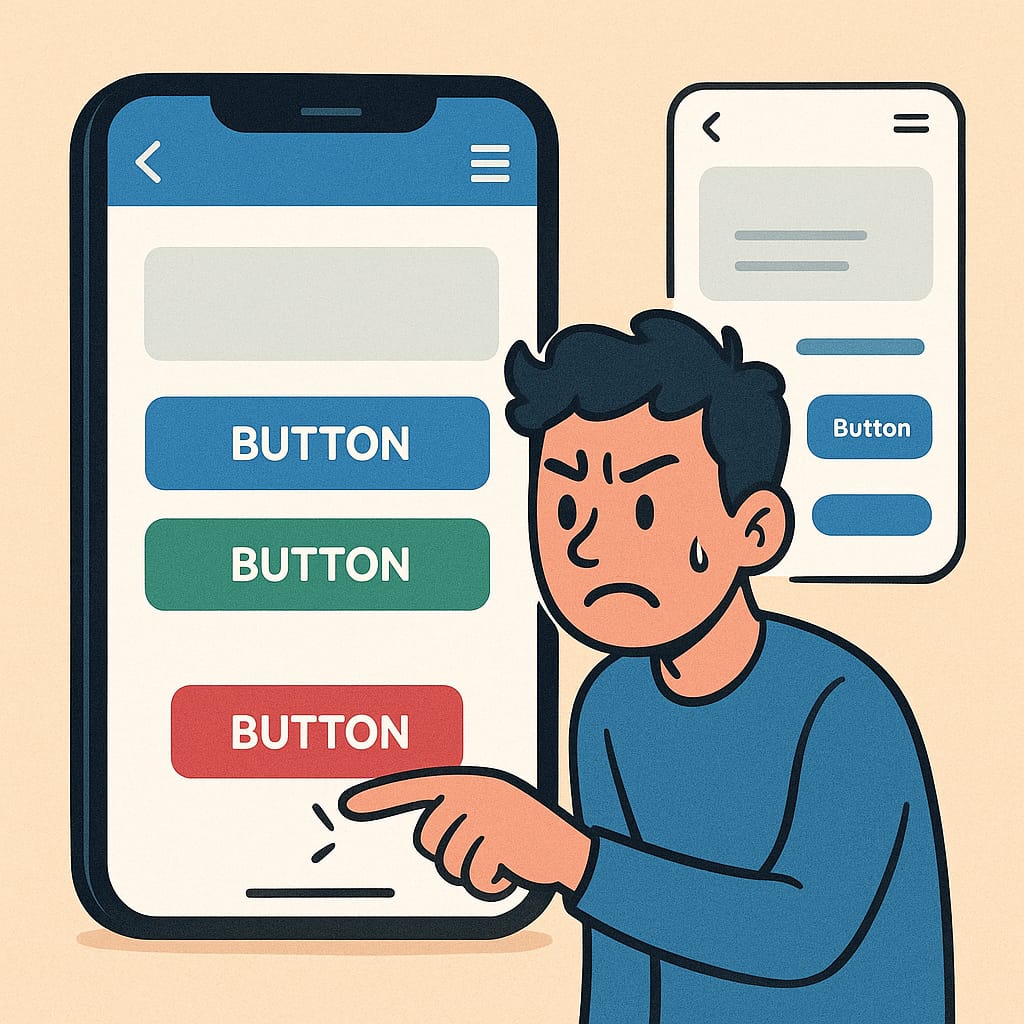
4. Overlooking UI/UX and User-Centered Design
Even if your app is technically excellent, it will die if the user experience (UX) is bad. A messy user interface, confusing navigation, or absence of intuitiveness will get users uninstalling in a matter of minutes.
- Why this error is prevalent
Firms tend to concentrate too much on backend operations and consider design an afterthought. - Effects:
- 70% of users drop apps with poor navigation.
- 90% of users discontinue use of an app due to poor performance or poor design.
- Poor UX kills word-of-mouth referrals.
- Instead, do:
- Spend on UI/UX studies and wireframing prior to coding.
- Maintain the design clean, intuitive, and user-friendly.
- Follow platform-specific design recommendations (Material Design for Android, Human Interface Guidelines for iOS).
- Test prototypes with actual users before launch.
Takeaway: Design in app development is not only about aesthetics—it's about usability, retention, and brand perception.
⸻
5. Selecting the Wrong Technology Stack
The technology stack you use (programming languages, frameworks, and databases) has a direct impact on your app's performance, scalability, and long-term viability.
- Mistakes businesses make:
- Selecting a stack simply because the dev team is comfortable with it.
- Utilizing outdated technologies that don't scale.
- Not considering whether to build native apps, hybrid apps, or cross-platform apps.
- Why this is dangerous:
Choosing the wrong stack can result in: - Performance bottlenecks (slow loading, lag).
- Compatibility issues with future updates.
- High maintenance costs when scaling.
- What to do instead:
- Align tech choices with business goals and future scalability.
- For high-performance apps (like banking or gaming), go for native development.
- For fast go-to-market apps, cross-platform frameworks like Flutter or React Native may be better.
- Always take advice from seasoned architects before making a decision.
Takeaway: A weak tech foundation will constrain your app's potential regardless of how excellent the idea.
6. Lack of App Performance and Speed Optimization
Regardless of how nice your app is or how many bells and whistles it has, if it's sluggish, users will leave. With today's fast-paced digital age, individuals expect apps to load in two seconds or less. Anything more and they leave the app or uninstall it completely.
- Why companies are failing in this
Companies tend to focus on introducing new features or pushing updates in a hurry, forgetting that optimizing performance is equally important as functionality. Developers may test on fast internet or premium devices and overlook how the app will function on slow internet or mid-range devices. - Effects of neglecting speed:
- Increased bounce rates (users leaving the app without finishing any activity).
- Bad ratings and reviews in stores.
- Losing market to competitors who offer seamless, faster experiences.
- What to do instead:
- Optimize code, images, and APIs for quick loading times.
- Enable caching and data compression whenever possible.
- Test on multiple devices, operating systems, and network conditions.
- Regularly monitor performance using tools such as Firebase Performance Monitoring, New Relic, or AppDynamics.
Takeaway: Users will forgive missing features, but they will not forgive slow, buggy, or laggy apps.
⸻

7. Poor Security Measures and Ignoring Data Privacy
We are living in an age where cybersecurity is not a choice—it's a necessity. Users entrust your app with confidential data: personal data, payment data, and sometimes even healthcare information. But numerous firms make security an optional "phase 2" consideration rather than including it from day one.
- Common security errors:
- Saving passwords or user information in plaintext.
- Failing to encrypt communication between the app and server.
- Poor authentication mechanisms (simple passwords, no 2FA).
- Not complying with laws such as GDPR (Europe), CCPA (California), or India's DPDP Act (2023).
- Why this is risky:
One data breach can ruin years of reputation and trust. For instance, various apps have been uninstalled by millions of users following big leaks. Companies also risk legal fines, money loss, and long-term reputation loss. - What to do instead:
- Always encrypt sensitive data (both while storing and transmitting).
- Implement secure authentication protocols (OAuth, JWT, biometrics, 2FA).
- Keep dependencies and frameworks up to date with bug fixes for security patches.
- Adhere to compliance requirements from the beginning instead of patching later.
Takeaway: Security is not an added feature—it's the building block. Without it, your app is one data breach away from disaster.
⸻
8. Forgetting About Regular Updates and Maintenance
App development is not done at launch—it's just the start. However, many businesses fall into the trap of making the launch day the endpoint, forgetting about constant updates, maintenance, and refinement.
- Why this occurs:
- Budget depletion after launch.
- Management believing that after the app goes "live," it will self-perpetuate.
- No long-term maintenance plan.
- Effects of no updates:
- Incompatibility with new iOS/Android versions.
- Users perceive the app as "dead" or abandoned.
- Security flaws accumulate over time.
- Frequent update-releasing competitors seem more innovative and dependable.
- Instead do:
- Budget post-launch (20–25% of development cost must go towards maintenance).
- Publish updates every 2–4 weeks for bug and performance fixes.
- Regularly gather user feedback and deploy feature upgrades in response.
- Monitor analytics (crash reports, retention rates, engagement levels) to inform updates.
Takeaway: Going live with an app without any maintenance plan is like purchasing a car and not giving it any servicing—it won't survive long.
⸻
9. Cross-Platform and Device Compatibility Neglect
Not all users own the latest iPhone or flagship android smartphone. Still, most companies just test their apps on a couple of high-end devices while neglecting compatibility with older versions of operating systems, mid-range devices, or even tablets.
- Prevalent issues:
- UI looks fine on iOS but broken on Android (or vice versa).
- Features crash on older versions of operating systems.
- Performance drops significantly on lower-end devices.
- Why this is dangerous:
- In India, Africa, and Southeast Asia, a majority of users still rely on budget or mid-range smartphones. Ignoring them means losing a massive market.
- Poor compatibility leads to bad reviews, which tank app store rankings.
- What to do instead:
- Test on a large number of devices (low-end and high-end).
- Support backward compatibility with a minimum of 2–3 older OS versions.
- Utilize frameworks such as React Native or Flutter to provide consistent cross-platform performance.
- Map responsive design principles to tablets and foldable phones.
Takeaway: A smoothly running app on various devices and platforms reaches a broader audience and earns trust.
⸻

10. Not Having a Strong Marketing and Launch Strategy
Even the most well-crafted apps do not succeed if no one knows about them. A staggering number of businesses invest enormous amounts in development but virtually nothing in marketing, branding, and launch promotion.
- Why this error occurs:
- Overconfidence: “If we build it, users will come.”
- No allocated marketing budget.
- Pressing marketing as an afterthought, not as a concurrent process.
- Results:
- Low downloads with an excellent app.
- Low visibility in app stores.
- Shunned opportunities for virality and brand awareness.
- What to do instead:
- Create pre-launch excitement through social media, teaser videos, and email campaigns.
- Optimize for App Store Optimization (ASO)—titles, keywords, descriptions, screenshots, and reviews.
- Get influencers, industry blogs, or PR agencies to cover your app.
- Measure launch performance using analytics and double down on what works.
Takeaway: A great app without a marketing strategy is like a film without a trailer—nobody knows about it.
⸻
Final Thoughts
App development is a process, not an event. Businesses that jump into it without planning end up making the same mistakes over and over again: skipping research, neglecting design, feature-bloating, and forgetting updates. The secret to success is to think of app development as a business initiative, not a technical undertaking.
By sidestepping these 10 most frequent errors, companies can dramatically increase their possibility of developing not only an app, but a thriving, lasting product that expands with customers and emerges in a busy digital market.


 Indian Online Marketing Team


